Category: education

Human-centred education aims at the development of the whole person and enabling the expression of full human potential through educational processes and practices. human-centred education can be characterized as an holistic approach to curriculum and assessment, flowing from human relations between teachers, students, parents and other members of the community, and is achieved through addressing the unity of human experience as a whole, within a stimulating human environment in the school classroom, playground, community and beyond. practice concerns itself with the development of personal qualities and dispositions such as curiosity, caring for others and inner integrity to actively engage and empower learners to shape rich, meaningful and flourishing experiences at school and in adult life and learning.

  • G20 Interfaith Forum,  Education Policy Statement, 2021

    G20 Interfaith Forum, Education Policy Statement, 2021

    “Young people are on the frontlines of the struggle to build a better future for all.” — António Guterres, UN Secretary-General

    “Children will never accept a return to ‘normal’ after the pandemic because ‘normal’ was never good enough.” — Henrietta H. Fore, Executive Director of UNICEF

    In 2021, through a Global Listening Initiative, the G20 Interfaith Forum Education Working Group partners brought forward voices of worldwide children and young people in the following policy statement. It highlights five practical implementable actions as follows:

    1. SAFEGUARD HEALING AND WELL- BEING AS A CORNERSTONE OF EDUCATION
      Education is essential not only to healing the trauma of COVID- 19, but also addressing the pre- existing epidemic of youth mental and emotional illbeing. Faith- sensitive conceptions and practices of healing and well- being should be considered to enrich educational effort to this end. This is a significant step that all G20 countries can
      take for education, guided by a common objective of nurturing students’ holistic well- being through education.
    2. ENGAGE YOUTH IN EDUCATIONAL DECISION- MAKING
      Youth have a significant part to play in educational decisions that directly affect their learning, well- being, and present and future lives. Therefore, all young people, including girls and youth from minority and vulnerable backgrounds, must be respected and engaged as actors, innovators, co- creators, partners, and advocates for transforming education. G20 leaders should consider faith communities as key partners for education in this regard as many have provided meaningful support in terms of youth engagement.
    3. ENSURE ALL LEARNERS’ EQUITABLE AND CONSISTENT ACCESS TO QUALITY EDUCATION
      To improve learners’ equitable experience of, and equal access to, good quality education requires a commitment to making digital technological infrastructures available in homes, schools, and communities. Broad G20 political partnerships and public and private investments in educational resources are key to educational inclusion.
    4. EMBED ECOLOGICAL AND GLOBAL CONCERNS IN CURRICULA AGENDA
      The world increasingly recognises the interdependence of human well- being and ecological flourishing, a spiritual understanding long advocated by global faith communities. Education can contribute significantly to young people’s deepened awareness of the need to decentralise human self- interest, and to recentre human
      responsibility for regenerating our ecological environment. With the support of faith-based partners, curricula agendas must be reformed to include and promote environmental education and direct experiences in/of nature, along with a deeper understanding of SDGs and the skills to support them.
    5. PRIORITISE TEACHERS’ WELL- BEING AND PROFESSIONAL DEVELOPMENT AND STRENGTHEN THEIR CAPACITIES TO FACILITATE BLENDED LEARNING
      Teachers’ well- being and continued professional development is essential to high quality education. With the strong possibility of future pandemics on the horizon, cultivating teachers’ capacities to facilitate student learning and well- being through online and blended media has become a key priority. Online CPD platforms and
      creative resources across G20 partnerships can serve to support the sharing of innovative practices and enable mutual learning. Faith- inspired conceptions of education and well- being can help strengthen teachers’ connection with the noble vocation.
  • G20 Interfaith Forum,  Global Listening Initiative, 2021

    G20 Interfaith Forum, Global Listening Initiative, 2021

    To understand how education can contribute to the above challenges, the IF20 Education Working Group partners launched a Global Listening Initiative (GLI). The aim of the GLI was two-fold: (1) to ground policy inquiry in existing global proposals, (2) to understand the lived experiences of children and young people in diverse contexts and engage them in identifying actions for educational transformation.

    The GLI consisted in two parts: an extended Desk Review to listen to the widespread calls to action from diverse international organisations, global educational commissions, religious communities, grassroots movement and scholars; and a global consultation to listen to young people and engage with their perspectives. Over two thousand adolescents (aged 14-19) from 26 countries across five continents took part in online and/or in-person workshops hosted by NGOs, schools, and faith-based organisations. Adolescents from diverse backgrounds were invited to reflect on their experiences of life and education during the Covid-19 pandemic; identify who and what have been most supportive to their learning and well-being; and propose educational policy priorities that can explicitly support their healing, learning and flourishing. Participants’ insights were drawn out through a deep listening and dialogic process, and immersive data analysis, bringing together themes arising from structured and unstructured facilitators’ and youth’s reports, images, drawings, and quotes from participants. Both processes have yielded rich understandings of the potentials to work purposefully through education programmes as ways to advocate for and advance equity, inclusion, and well-being. Conceptions of healing and well-being rooted in faith, indigenous and other spiritual traditions played an important part in guiding the GLI’s reflection.

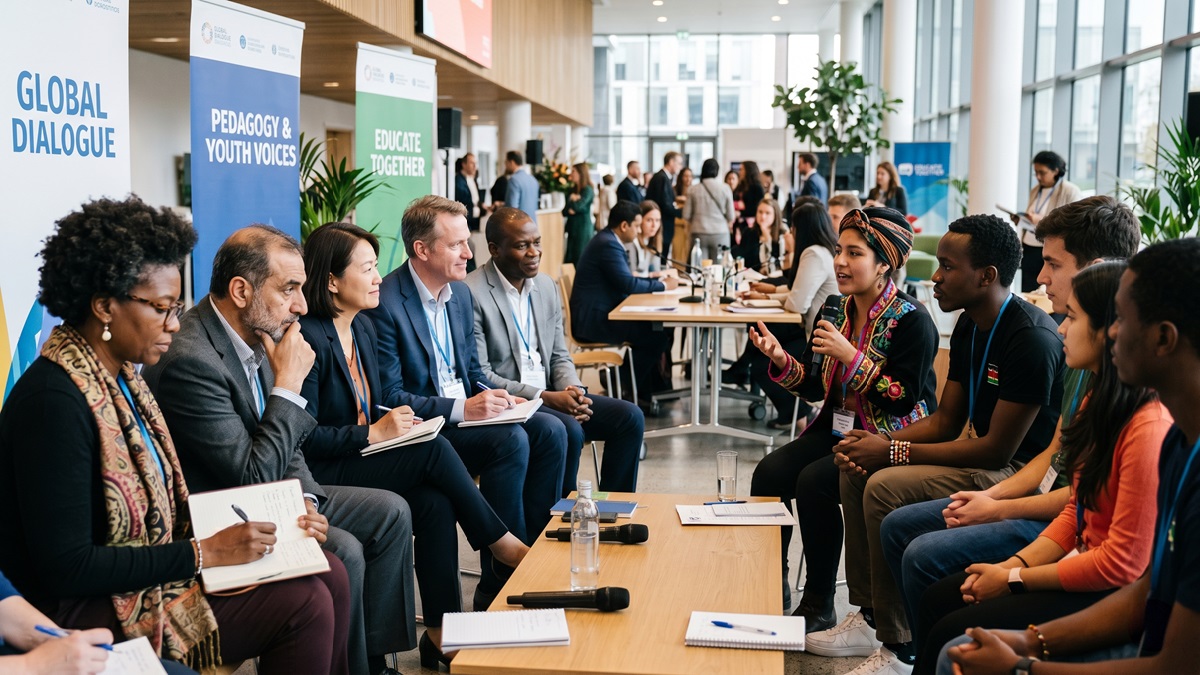
    Young people from India, Lebanon and UK representing the voices of global adolescents and shared their experiences of education and insights from the Global Listening Initiative in the following dialogue.

    Through listening, dialogue and inquiry, the G20 Interfaith Forum Education Working Group was able to bring children and young people’s voices forward through an educational policy brief, presented at IF20 Summit held in Bologna, September, 2021.


  • G20 Interfaith Forum, inclusive and caring education, 2020

    G20 Interfaith Forum, inclusive and caring education, 2020

    IF20 Education Task Force

    As part of the G20 Interfaith (G20 / IF20) Education-Task-Force, the GHFP launched a research into Inclusive and Caring Education from a Faith Perspective. The research consisted in two parts: (1) a Desk Review to understand better how religion/faith and spirituality tend to define inclusive and caring education; (2) a Questionnaire Survey to seek examples and case studies of faith-inspired approaches to inclusive and caring education.

    Three priority areas have emerged from our inquiries, which deserve further attention:

    1. Teachers’ professional development, especially towards enabling teachers to be more skilled at facilitating dialogic and collaborative learning in classrooms of rich diversity;
    2. Innovative approaches and practices of inclusive and caring education, notably in engaging girls, and other vulnerable students;
    3. Safe, caring and inclusive learning spaces, including through digital platforms.

    The G20/ IF20 Education Task Force invited high-level experts in the fields of education, faith and policy for an online consultation with the aim to review thematic proposals and make policy recommendations.

    Inclusive education offers paths to enhancing students’ motivation for participation and learning, raising self- and other-awareness, reducing biases, enriching relationships, increasing capabilities in team work, collaboration and conflict transformation, enabling a greater sense of belonging and community, reducing bullying and violence, and most importantly, improving wellbeing and opportunities for all. Without inclusive and caring approaches, vulnerable children and young people are not only discriminated against within the current systems, they are also excluded from broader opportunities for learning and wellbeing


    2020 G20 Interfaith Forum:
    Interfaith Approach to Advancing Inclusive Education

    G20 Interfaith (IF20) Education-Task-Force —>

    The key recommendations of the policy brief:

    1. Advancing the Wellbeing of Every Child as the Core Aim of Education 

    • Promoting wellbeing of all students in the learning community
    • Introducing inclusive curricula
    • Prioritising collaborative and co-creative learning in the classroom  

    2. Ensuring Participation of All in Inclusive Learning Environments 

    • Engaging [all] young people and empowering student voice and agency 
    • Forming partnerships among schools, families and faith communities to support all children 
    • Strengthening links between schools, faith communities, and wider society 

    3. Aligning Teachers’ Professional Development with a Wellbeing and Inclusion Focus

    • Reviewing national capability frameworks for teachers’ professional development
    • Enhancing teachers’ awareness, sensitivity, and appreciation of diversity and inclusion 
    • Enabling teachers to facilitate transformative, collaborative and dialogue-based learning  
  • Well-being in schools

    Well-being in schools

    On Wednesday 20th March, the GHFP’s Human-Centred Education team welcomed local secondary school’s Well-Being Leaders and Coordinators from across Brighton and Hove to join us for a twilight seminar “A Whole-School Approach to Well-Being in Secondary Schools“.

    The seminar offered an opportunity to explore and share good practices on well-being and inclusion and to make links with local colleagues. It will begin with an inspiring keynote from Professor Colleen McLaughlin, Emeritus Director of Education Innovation at the University of Cambridge. The discussion was followed by a facilitated open dialogue and sharing, through which participants develop a rich understanding and awareness of critical issues relating to student and staff well-being in secondary schools.

  • Spirituality and Education Symposium, 2012

    Spirituality and Education Symposium, 2012

    International Symposium on Religion Spirituality and Education for Human Flourishing.


    24-26 FEBRUARY 2012, Marrakech, Morocco.
    Co-Convened by Guerrand-Hermès Foundation for Peace and UN Alliance of Civilizations ‘Education about Religions and Beliefs’ Project.

    Re-defining religious education: Spirituality for Human Flourishing

    An edited book of papers, ISBN 978-1-137-37389-2 is published by Palgrave Macmillan.

    This book is a unique collection of interdisciplinary articles that argue for religious education to be directed primarily towards the spiritual insofar as it is part of a flourishing human life. The articles address this issue from the perspectives of theory, different religious traditions and innovative teaching and learning practices.


    For a large proportion of the people in the world, spirituality is an important part of being human and often thought to be an essential element of a flourishing life. Today’s world is facing unprecedented challenges and opportunities, and so there is a pressing need to educate in order to develop a deeper awareness of the spiritual dimensions of our lives. In this context, we are interested specifically in exploring the part that religious education can play in cultivating human virtues and spirituality. Under various names, such as ‘education about religion’, ‘faith education,’ ‘religious studies,’ and ‘religious education,’ the teaching of religious beliefs has already been integrated into the national curricula of many countries.

    However, the focus of religious education is generally to impart knowledge about religions, and perhaps gesture towards some inter-religious understanding. This way of approaching religious education tends to regard religion as an academic subject, and because such education is at arms-length, the spiritual and experiential aspects of religion are not made directly available to students.
    The Symposium aimed to go beyond the current knowledge-centred approaches to religious education and offered a space to discuss and debate the following questions:

    In what ways can education of/from religions better contribute to young people’s spirituality and to the flourishing of their lives?
    How can these contributions of religions be better integrated in schooling?

    The objectives of the Symposium were:

    • To establish a common platform or framework for understanding the positive contributions of religions towards spirituality;
    • To identify the ways in which educational systems can facilitate or nurture such spirituality;
    • To examine the pedagogical implications and challenges of such educational programmes;
    • To identify a set of good questions for further inquiries and possible research.

    Prior to the Symposium, each of the participants wrote a scholarly paper to address some aspect of the main questions that the Symposium aims to explore. These papers were circulated to all the participants before the event and served as resources for the discussions and conversations during the event. The Symposium lasted three days. Each day, there were plenary sessions, group discussions, and optional sessions of religious and spiritual practices offered by the participants from their own traditions.